A construction estimator measures a job off its drawings and prices it, to work out what it will cost to build before it's tendered or started. A quantity surveyor estimates costs too, then manages them across the life of a project: cost plans while the design develops, progress payments during the build and depreciation schedules once it's finished. If you need the cost to build off your plans, or a bill of quantities to tender and order from, an estimator can give you both. If you need the cost monitored and the progress payments approved through construction, or a tax depreciation schedule on an investment property, you want a quantity surveyor.
What does a construction estimator do?
The Australian Institute of Quantity Surveyors (AIQS) describes an estimator as someone who quantifies the materials, labour and equipment needed to complete a construction project and calculates the total that sets the project's budget (AIQS). A production estimator, on the same list, prepares bills of quantities, takeoffs and purchase orders and prices client variations.
On a job, the estimator's work looks like this:
- reading the plans, elevations, sections and engineering
- measuring each quantity off them in square metres, lineal metres, cubic metres or a count of items
- pricing every quantity against a rate library
- setting the lines out in the trade groups and cost centres a builder works in
- carrying an allowance for anything the drawings don't settle, like the soil class or the depth of the piers
- listing what the estimate excludes
Our estimates go to builders, developers and owner-builders who need a price for a budget, a feasibility, a tender or an order list before the job is built.
What does a quantity surveyor do?
Victoria's Building and Plumbing Commission (BPC) registers quantity surveyors as building practitioners. Its guide to quantity surveying work says a registered quantity surveyor is responsible for estimating and monitoring construction costs for all classes of building. It sets the work out by stage (BPC):
- Before construction, a quantity surveyor may prepare cost plans at concept design, design development and tender, help prepare the tender documents (bills of quantities or schedules of rates) and help evaluate and select builders.
- During construction, they monitor spending against the budget, report on how changes affect the cost, and may provide monthly cashflow forecasts and approve monthly progress payments.
- At completion, they may produce tax depreciation schedules and replacement cost estimates for insurance. If it's needed, they may also support mediation or arbitration.
The AIQS describes the role the same way, as estimating and monitoring the costs of construction through the lifetime of a building, from feasibility through design and construction to demolition or repurposing (AIQS).
Where the two roles overlap
Estimators and quantity surveyors both read drawings, measure quantities and prepare bills of quantities. The AIQS lists Estimator, Production Estimator and Senior Building Estimator among the job titles within the quantity surveying profession. It also says quantity surveyors work for builders, developers, engineering firms, government agencies and quantity surveying firms.
The difference is how far the work runs. An estimator prices the job before it's built, where a quantity surveyor can carry the cost and the contract on through construction to completion.
How quantity surveyors are qualified and registered
The AIQS accredits quantity surveying and construction degrees at universities in the ACT, New South Wales, Queensland, Victoria, South Australia and Western Australia (AIQS). Becoming a Certified Quantity Surveyor through the AIQS includes an Assessment of Professional Competence, an interview of about 60 minutes in front of a panel of three assessors (AIQS). You can look up a member or a firm in the AIQS directories.
For registration in Victoria, the BPC accepts a construction management degree from RMIT, Deakin or Holmesglen, among others, as the knowledge required. It also asks for at least two years of supervised practical experience in quantity surveying work (BPC). You can check a practitioner's registration on the BPC register.
What is a quantity surveyor report?
On a rental property, a quantity surveyor report can be the evidence of construction costs behind a tax claim. To claim capital works deductions, the ATO says you must provide evidence of the construction costs, either documents that show the costs, like receipts, or a report written by an appropriately qualified person (ATO). If you don't have the records, you'll need the information from the previous owner or from one of the qualified people the ATO lists, starting with a quantity surveyor. The ATO says a quantity surveyor's report can also include a schedule of depreciable assets.
During a build, a quantity surveyor's reports track spending against the budget and how changes affect the cost.
We don't prepare tax depreciation schedules or bank valuations. Our estimating terms say an estimate from us isn't a bank valuation (our estimating terms). For a depreciation schedule, talk to a quantity surveyor.
Do you need a quantity surveyor or an estimator?
Start with what you need the numbers for.
- To set a budget or test a feasibility on a house, a duplex or a townhouse development, an estimator gives you the cost to build off the plans.
- To tender a job, get every trade pricing the same quantities or order materials, you need a bill of quantities from an estimator or a quantity surveyor.
- For cost plans while the design is still changing, from concept onwards, a quantity surveyor does that work.
- To have spending monitored and progress payments approved during the build, you want a quantity surveyor.
- For a tax depreciation schedule on an investment property, or a replacement cost estimate for insurance, you need a quantity surveyor.
What an estimate off your plans looks like
Our sample estimate for a single storey home shows what an estimator hands over. The house is 198.32 m2 and the estimate comes to $561,086 including GST. The standard estimate gives that total across twelve trade groups, from site preparation and the slab through to internal fit-out and external works. Each group is marked From the plans, Allowance or Quote.
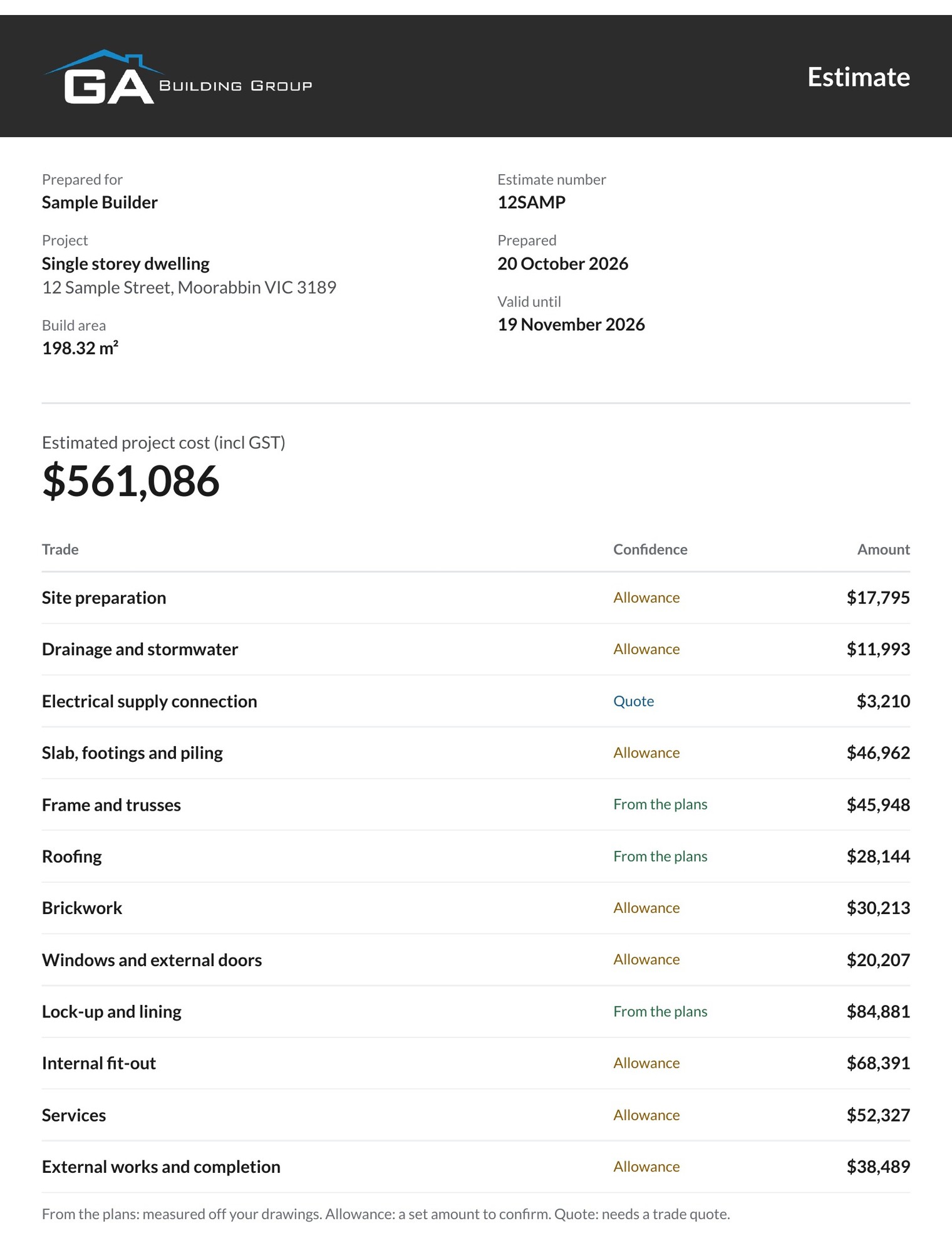
The full line-by-line takes the same job to 312 lines across 83 cost centres. The wall frames are measured off the plans, 194.2 m2 of pre-fab frames at $76.70 a square metre for $14,895. The roof trusses are priced over the 218.2 m2 roof area. The floor coverings are an Allowance, 157.4 m2 of carpet and timber to selection at $102.46, $16,127 in all. That's the line to firm up once the selections are made.
A builder can hand each trade its own lines and get every quote back on the same quantities. Items like tree removal, demolition or a new crossover are listed as excluded when the plans and the form don't show them. The estimate is valid for 30 days from the date on it.
What our estimating service covers
We're estimators. We've been building in Melbourne since 2005 and price every job in our specialised estimating program against our own rate library of approximately 6,000 items. Jobs anywhere in Australia are priced on the price list for their state. Our estimator checks each estimate before it's emailed to you, within 48 hours (two business days) of your plans and payment coming in.
A standard estimate starts at $399 + GST on a single storey home and the full line-by-line, our bill of quantities, at $799 + GST. A duplex or dual occupancy starts at $399 + GST for one new dwelling. Every fee is on Construction Estimating Services.
The estimating fee doesn't include site inspections or measured surveys, design or engineering, building approvals, tender administration, or financial, legal, insurance or valuation advice. Upload your plans on our estimate form to see your exact fee before you pay.